
Funeral Poems and Readings: A Curated Collection
Funeral Poems and Readings: A Curated Collection
You are planning a service and you need a reading. Maybe the officiant asked for one, maybe you want to add something personal, or maybe you just need a few minutes in the service that are not about you standing up and trying not to cry. This collection of funeral poems and readings is meant to help you find something that sounds like the person you are remembering.
A good reading does something specific: it gives the room permission to feel. It carries part of the emotional weight so the speakers do not have to carry all of it. Below you will find classic and modern poems, religious readings, secular pieces, short readings for a tight service, and honest advice on how to choose the one that fits. Take what you need.
How to Choose a Funeral Reading
Before you scroll through poems, take two minutes to think about the person. The right reading is less about which poem is famous and more about which poem sounds like them.
Ask yourself:
- Were they religious, spiritual, or neither?
- Did they love words, or tolerate them?
- Were they private or public?
- What did they actually sound like when they talked about life and death?
- Would they have picked this poem for their own service?
The last question is the most useful. If the person would have rolled their eyes at a poem, do not read it at their funeral, no matter how beautiful it is.
Here's the thing: a reading that does not match the person creates a small wrong note in the room, and people feel it even if they cannot name it. A reading that does match — even a short, simple one — lands.
The Four Big Categories
Most funeral poems fall into one of four groups:
- Comfort readings — offered to the mourners, not about the person who died. They say: you are not alone, this pain has been felt before.
- Tribute readings — about the person who died. They say: here is who they were.
- Legacy readings — about what the person leaves behind. They say: they are still with us in these specific ways.
- Spiritual or religious readings — about what happens next, or about the soul. They say: death is not the end.
A full service often includes one from each category. A smaller service works well with just one well-chosen reading.
Classic Funeral Poems
These are the pieces that have been read at funerals for decades or centuries. They endure because they hit something true.
"Do Not Stand at My Grave and Weep" — Mary Elizabeth Frye
Probably the most read funeral poem in English. It is short, it is plain, and it is spoken in the voice of the person who died, which is unusual and powerful.
"Do not stand at my grave and weep, I am not there. I do not sleep. I am a thousand winds that blow, I am the diamond glints on snow..."
When to use it: any service, religious or secular, when the family needs comfort. It works especially well when read by a grandchild or niece — a younger voice makes the poem feel newly written.
"Remember" — Christina Rossetti
A short Victorian sonnet that gives the mourners permission to move on, but gently.
"Remember me when I am gone away, Gone far away into the silent land..."
When to use it: for someone who was protective of their loved ones, who would not want the people they left behind to stay stuck in grief.
"Funeral Blues" — W.H. Auden
Better known as "Stop All the Clocks," made famous by Four Weddings and a Funeral. This one does not console. It names the size of the loss and refuses to be comforted.
"He was my North, my South, my East and West, My working week and my Sunday rest..."
When to use it: when the loss is enormous and you need the room to feel that, not feel better. Especially fitting for a spouse or a partner.
"Death Is Nothing at All" — Henry Scott Holland
Often attributed as a standalone poem, it is actually a passage from a sermon. It reads as if the person who died is speaking directly to the mourners.
"Death is nothing at all. I have only slipped away to the next room..."
When to use it: at Christian services, or at any service for someone who lived in close conversation with their family. The conversational tone fits that kind of life.
Modern Funeral Readings
Newer pieces can land harder than the classics because the language is current. The reader does not have to push through Victorian phrasing.
"The Dash" — Linda Ellis
This one is a reading, not really a poem. It is built around the dash between the birth year and death year on a headstone — what you did with the years in between.
When to use it: when you want a reading that gives the mourners something to take home. It works well at celebrations of life for someone who lived with intention.
"When Great Trees Fall" — Maya Angelou
A piece about loss on a large scale. Angelou is talking about what it feels like when someone central to your life dies.
"When great trees fall, rocks on distant hills shudder..."
When to use it: for a parent, grandparent, mentor, or community leader — someone whose absence changes the shape of a whole family or neighborhood.
"She Is Gone" (also called "He Is Gone") — David Harkins
A poem built on two columns of choice. It names the two options every mourner faces: grieve that they are gone, or celebrate that they lived.
"You can shed tears that she is gone, or you can smile because she has lived..."
When to use it: famously read at Queen Elizabeth II's mother's funeral. Works for any service, especially ones billed as a celebration of life.
"Let Me Go" — Christina Rossetti (attributed)
A shorter, gentler version of the "do not mourn" category. Good for quieter services.
Religious and Spiritual Readings
If the service is religious, the officiant usually picks the scripture. But you can add a second reading. Here are the most common.
Christian Readings
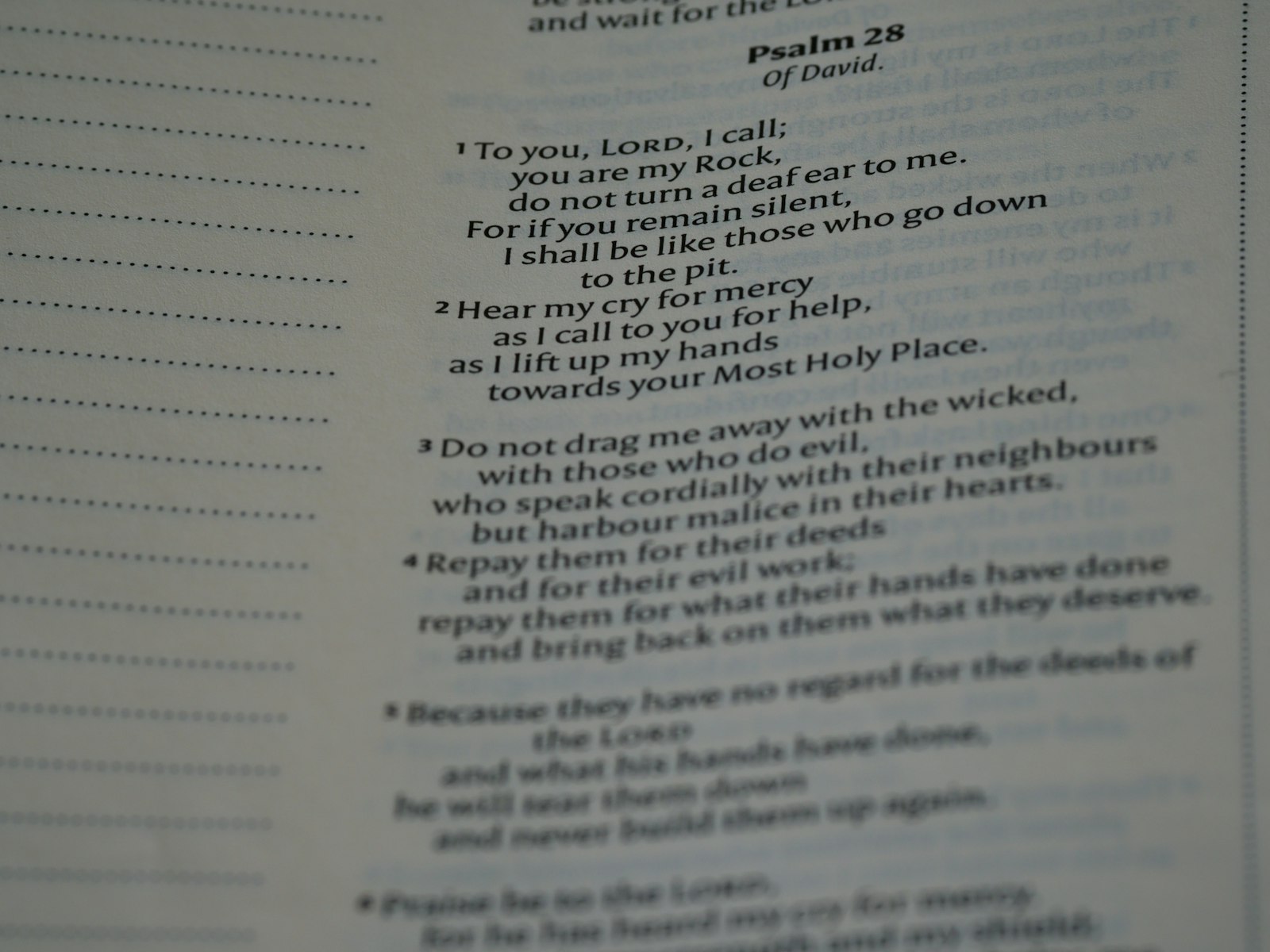
- Psalm 23 — "The Lord is my shepherd." The most familiar and most comforting. Works across denominations.
- Ecclesiastes 3:1-8 — "To everything there is a season." Secular enough that many non-religious services use it too.
- 1 Corinthians 13 — "Love is patient, love is kind." Usually a wedding reading, but it works beautifully for a long marriage ending in loss.
- Romans 8:38-39 — "Neither death, nor life... shall be able to separate us from the love of God."
- John 14:1-6 — "In my Father's house are many mansions."
Jewish Readings
- Psalm 23 — shared with Christian tradition.
- Psalm 121 — "I will lift up mine eyes unto the hills."
- Proverbs 31:10-31 — "A woman of valor, who can find?" Often used for a matriarch.
- "We Remember Them" by Sylvan Kamens and Jack Riemer — a modern Jewish reading used at many memorial services.
Buddhist and Secular Spiritual Readings
- "The Buddha's Sermon at Rajagaha" — on impermanence.
- "When Death Comes" — Mary Oliver. Not strictly religious but deeply spiritual.
- "Kindness" — Naomi Shihab Nye.
Secular Readings That Are Not Poems
Sometimes a poem is not right. Sometimes prose is better. Here are passages that work at funerals:
- "The Prophet" on Death — Kahlil Gibran. The chapter on death from The Prophet reads well aloud and is not tied to any religion.
- "The Velveteen Rabbit" — Margery Williams. The passage about what it means to become real, often used at services for children or for someone whose love made others feel real.
- Letters — a letter the person wrote, or a letter to them. A great-grandchild reading a letter to a great-grandparent is one of the most moving things you will ever hear.
- Song lyrics — printed as text and read aloud. "Forever Young" by Bob Dylan, "The Parting Glass" (traditional), "Time in a Bottle" by Jim Croce.
The good news? You do not have to use a published piece at all. A well-chosen paragraph from a letter, a journal, or even a text thread can carry a whole service.
Short Readings for a Tight Service
If the service is running long or if you need something compact, these are the short options:
"To live in hearts we leave behind is not to die." — Thomas Campbell
"What we have once enjoyed deeply we can never lose. All that we love deeply becomes a part of us." — Helen Keller
"Say not in grief 'he is no more' but live in thankfulness that he was." — Hebrew proverb
"Those we love don't go away, they walk beside us every day. Unseen, unheard, but always near, still loved, still missed, and very dear." — Anonymous
Any one of these can stand alone at a graveside service, as an opening before the eulogy, or as a closing benediction. They take under 30 seconds to read and do not ask the reader to hold it together for long.
Matching the Reading to the Person
Let me give you some concrete pairings.
For a gardener or outdoors person: "Do Not Stand at My Grave and Weep" (the imagery is entirely natural), or Mary Oliver's "When Death Comes."
For a teacher or mentor: "When Great Trees Fall" by Maya Angelou, or a passage from Gibran's The Prophet on teaching.
For someone who loved music: song lyrics from one of their favorite songs, read aloud rather than played.
For a parent of young children: "The Velveteen Rabbit" passage on becoming real, or "Warm Summer Sun" by Mark Twain.
For a religious grandparent: Psalm 23, plus a short secular poem the grandchildren can read together.
For a private, quiet person: "Remember" by Christina Rossetti. It matches the scale of a quiet life.
For a big personality: "Funeral Blues" by Auden, or a piece of their own writing if they left any.
How to Read at a Funeral
If you are the one reading, a few practical things will help.
Before the Service
- Print the piece in large font. 14-point minimum, double-spaced. Your hands will shake.
- Read it aloud three times at home. Notice where you want to pause or breathe.
- Mark the pauses with slashes on the page. Physical marks are easier to follow than mental plans.
- Decide how you want to introduce it. One sentence is enough. "This was Mom's favorite poem" is better than a paragraph of explanation.
At the Podium
- Walk slowly to the front. Take the moment.
- Place the paper down. Do not hold it if you can avoid it.
- Look up before you start. Take one breath.
- Read slower than feels natural. Grief makes people rush.
- If your voice catches, stop. Take a breath. Continue. The room will wait.
- When you finish, pause for one full beat before walking away. That silence is part of the reading.
You might be wondering what to do if you cannot finish. Ask someone before the service to sit in the front row as a backup. If you break down, they come up and finish it for you. That is not a failure. That is good planning.
Putting a Reading Together With the Eulogy
A reading and a eulogy do different jobs. The reading carries the universal part — the grief that belongs to every mourner. The eulogy carries the specific part — who this person was. A good service uses both.
A simple structure that works:
- Welcome by the officiant.
- Short opening reading (comfort category).
- Eulogy (tribute — the personal stories).
- Second reading or music (a rest for the room after the eulogy).
- Closing words (spiritual or legacy category).
If you are responsible for only the reading and someone else is giving the eulogy, ask them what tone they are going for and pick something that complements rather than repeats it. If the eulogy will be funny, a softer reading before it gives the humor room to breathe. If the eulogy will be heavy, a gentler reading afterward helps the room recover.
Writing Your Own Reading
You can also write your own. A few sentences of your own prose, delivered honestly, beat a famous poem that does not fit. Try this structure:
- One sentence about who they were at their core.
- One or two sentences of a specific image or memory.
- One closing sentence about what endures.
For example:
"Dad was a man who believed any problem could be fixed with the right wrench and enough patience. I watched him spend an entire Saturday trying to save a toaster that cost twelve dollars, because he hated the idea of throwing anything away. He did not really save the toaster. But he taught me that trying to save things is usually worth it, even when it isn't."
That is 62 words. It took probably 20 minutes to write. And it will outlast any poem because it is only about him.
Related Reading
If you'd like more help, these may be useful:
Frequently Asked Questions
How do I choose the right funeral poem?
Start with what the person was like, not what sounds impressive. Ask yourself whether they were quiet or loud, religious or not, sentimental or plainspoken. A poem that sounds beautiful but does not sound like them will feel off in the room. Read three or four options out loud before you decide.
How long should a funeral reading be?
One to three minutes is the sweet spot, which works out to roughly 150 to 400 words. Long readings lose the room, especially when people are tired and grieving. If a piece you love runs long, read only the strongest stanza or section.
Can I use a non-religious poem at a religious funeral?
Usually yes, as long as it is respectful in tone. Many religious services include one scripture reading and one secular poem. Check with the officiant or clergy if you are unsure. Most are flexible as long as the poem is not openly contrary to the faith.
Should I read the poem myself or ask someone else to?
Ask someone with a steady voice who knew the person. Grief makes reading aloud hard, and short readings are often best delivered by a friend or niece or nephew rather than a spouse or child. Choose someone who can finish the piece if their voice catches.
Is it okay to use song lyrics as a funeral reading?
Yes. Lyrics read aloud work well, especially lyrics from a song the person loved. Print the verse or two you want to read rather than the full song. Attribute the songwriter clearly when you introduce it.